THE DEEP CHECK
An Evidence Base Investigation of Fact and Fiction
IT IS WEATHER, CLIMATE CHANGE or GLOBAL WARMING ?
Weather refers to atmospheric conditions that occur over short periods of time. (NASA)
Climate Change refers to changes of 30 years or more for regional or global temperature, humidity, and rainfall patterns. (NASA)
Global Warming or Cooling is Climate Change taking place on a global basis such as The Little Ice Age while Climate Change may apply to one or more regions but not necessarily the whole world as was the case of The Medieval Warm.
The Sahara Desert wasn’t a desert 4,500 years ago. The light yellow area was grassland, the light green area was mixed woodland and grassland. The Fertile Crescent was cooler and greener than today’s arid land.
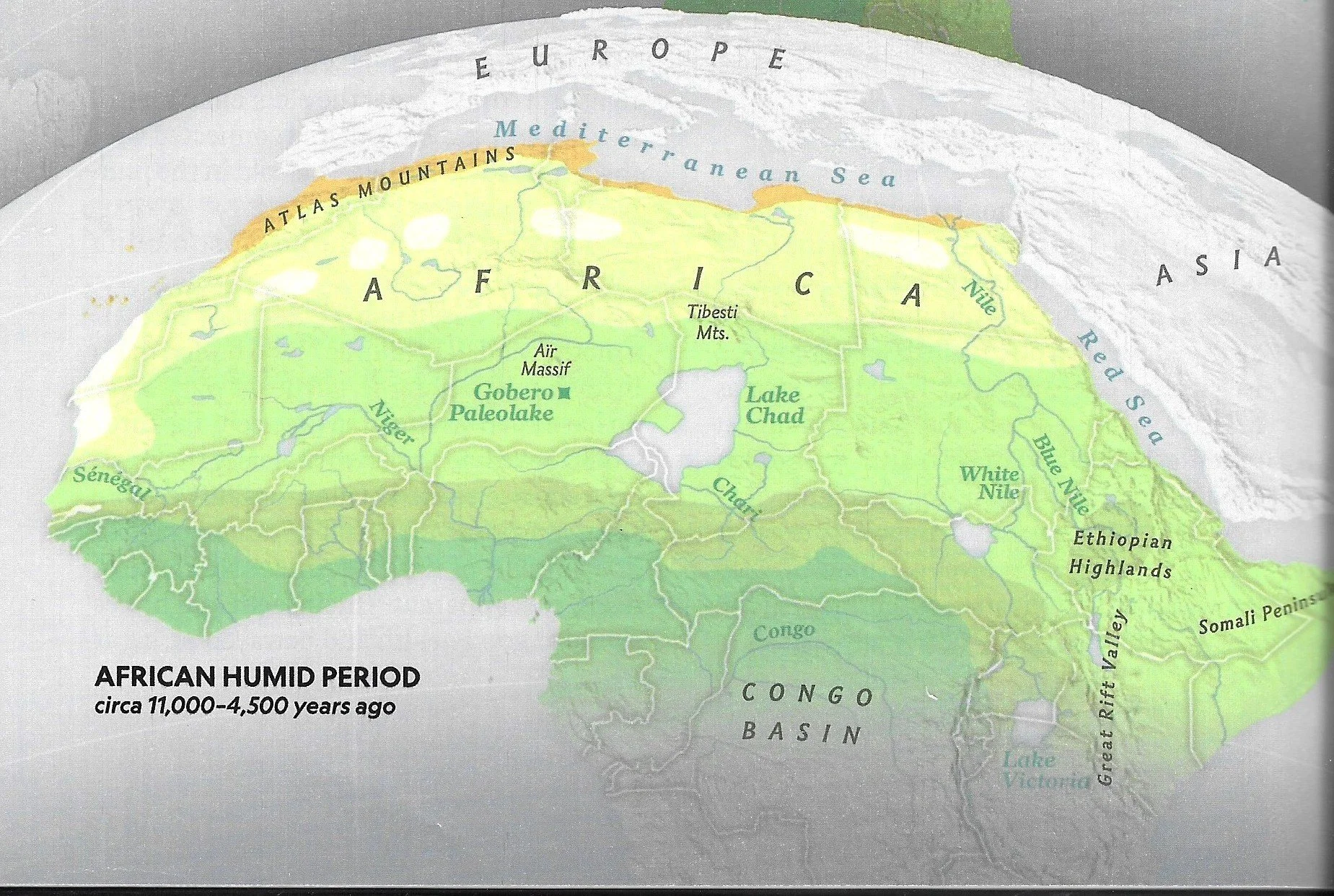
Courtesy of National Geographic, Volume 246
116,000 YEARS of CARBON DIOXIDE and CLIMATE CHANGE
116,000 years ago the most recent ice age began, freezing all of northern Europe, Russia and half of North America. Carbon dioxide sank to 180 parts per million (ppm).
20,000 years ago the world began a roller coaster of warming and chilling that ended after the Younger Dryas 11,500 years ago. Carbon dioxide had risen from 180 ppm to 240 ppm.
10,000 years ago the world was 1.5 C (2.7 F) hotter than it is today (2020 - 2025) and stayed hotter for the next 4,000 years. Carbon dioxide slowly rose to 260 ppm
6,000 years ago the temperature dropped to what we have today and stayed that way for the next 4,000 years. Carbon dioxide rose to 280 ppm.
2,000 years ago the temperature began a 1,500 year decline to the start of the Little Ice Age 550 years ago. Carbon dioxide levels stayed at 280 ppm.
Carbon dioxide began to rise in 1750 CE. Temperature began to rise in 1830 CE.
That was the first time in 10,000 years that temperature and carbon dioxide moved in the same direction at about same time.
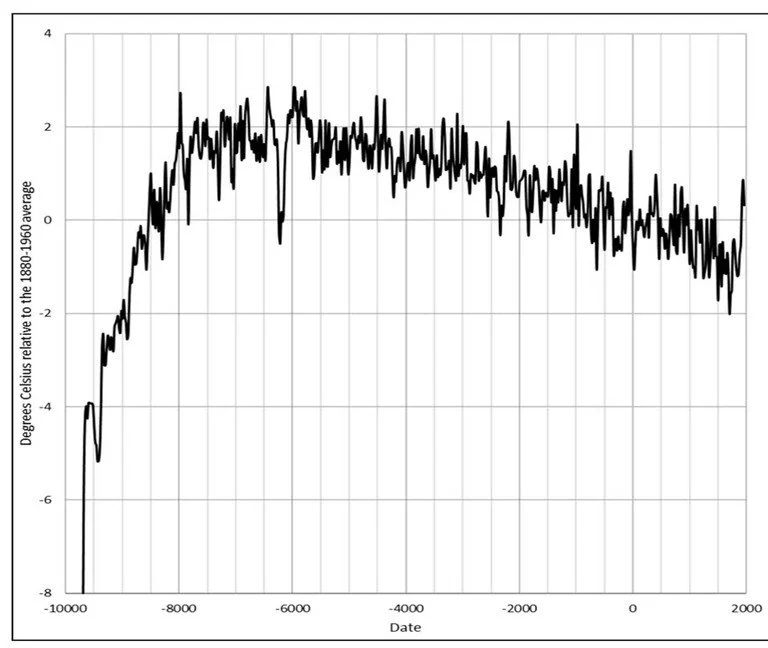
Dr. Vinther’s 12,000 Year Graph of six Greenland ice cores begins 11,500 years ago emerging from the frigid Younger Dryas years. Zero on the vertical temperature axis is the 1880 to 1960 CE average temperature. The 2000 CE temperature at the right side of the graph is 1 C (1.8 F) higher than that 80 year average still but 2 C (3.6 F) lower than the period shown as 8000 to 4000 BCE.
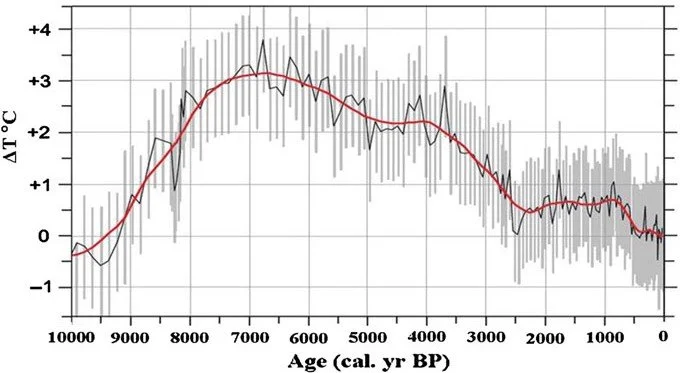
BAC II’s 10,000 Year Graph of the Baltic Region shows the same data line over the same time period as the Vinther graph above and the Rosenthal graph below. The red and black lines show moving averages. There were century long temperature peaks six to eight thousand years ago that were 3 C (5.4 F) higher than today. Perhaps our current rise of 1.5 C over two centuries isn’t historically exceptional.
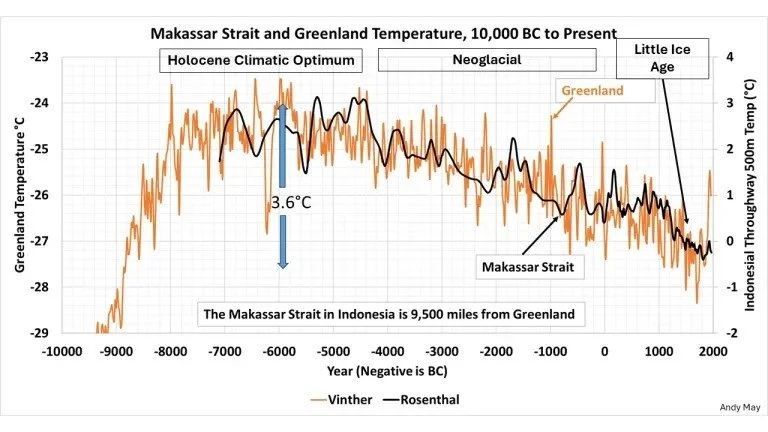
Dr. Rosenthal’s Graph 12,000 Year Graph of the Makassar Straight (tropical temperatures) overlays his data (black line) on Dr. Vinther’s Greenland graph. Global temperature changes are generally less responsive in the tropics because the sun is always directly overhead providing a constant maximum solar radiation. The further away from the tropics, the greater the variation in solar radiation. The exception was Antarctica which is relatively isolated by the Antarctic Oscillation (atmosphere) and Circumpolar (Ocean) Current.
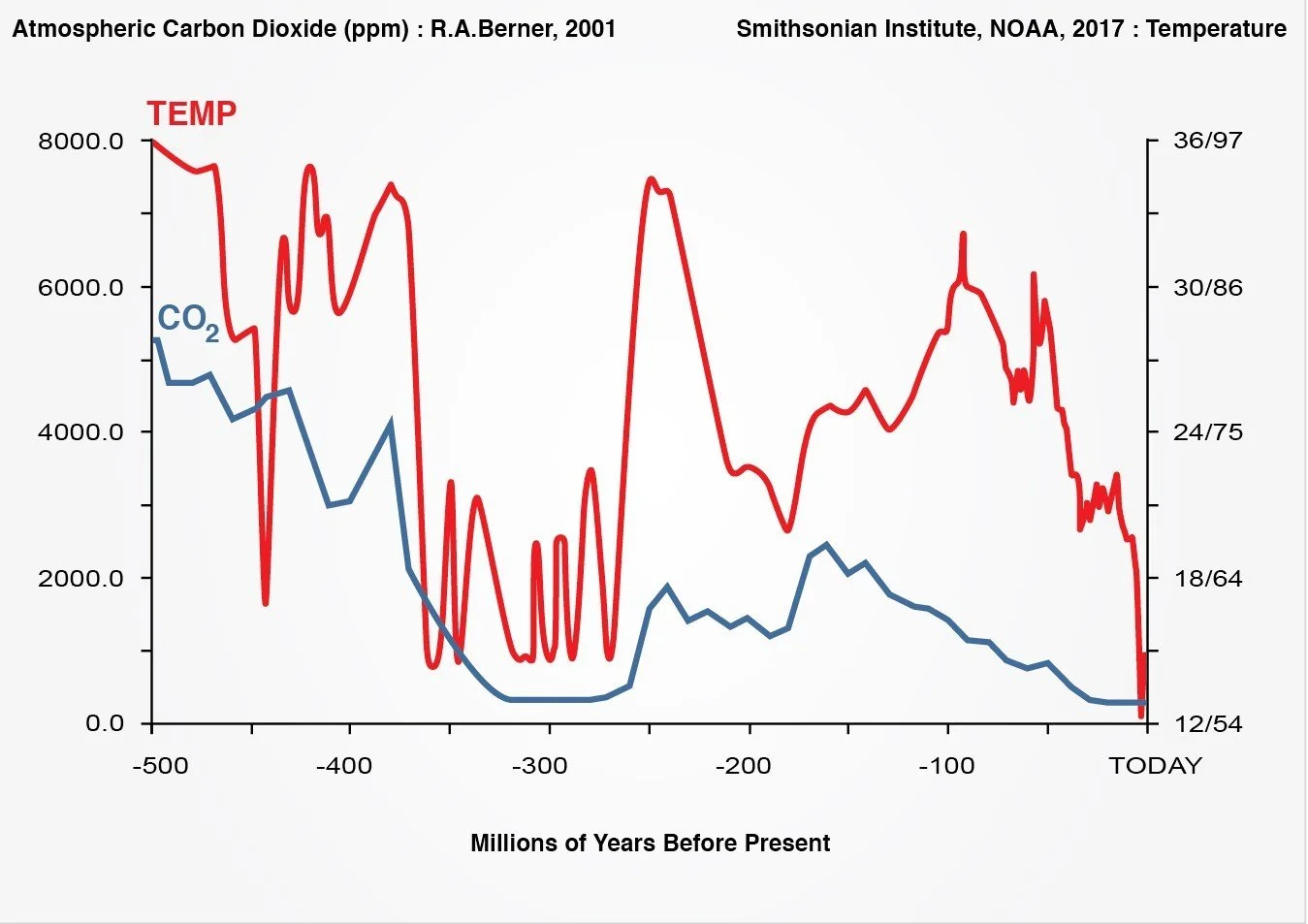
500 Million Years of climate history shows that earth’s greenhouse gases and temperature appear to move independently of each other. The graph is based on the carbon 14 isotope and oxygen 18 isotope both of which are created by solar radiation impacting the respective molecules in the thermosphere. The graph was created for this website overlaying Dr. Robert A. Berner’s carbon dioxide data on the Smithsonian Institute graph showing temperature data from NOAA.
WHY DO WE BELIEVE CARBON DIOXIDE IS CAUSING CLIMATE CHANGE
The early data analysis of the Greenland and Antarctic ice cores appeared to show carbon dioxide leading temperature. Al Gore championed it in his 2006 book An Inconvenient Truth and speaking tour. The media covered it, people began to accept it and politicians chased the votes. The climate appear to be changing and many have accepted the mantra that carbon dioxide and the other greenhouse gases are the cause.
The idea was proposed in 1895 but languished until 1959 when Dr. Roger Revelle, a highly respected oceanographic scientist, said it might be possible in the scientific journal Tellus (Volume 9, Issue 1, Page 27). Climate scientists couldn’t understand what caused climate change. When the early Greenland and Antarctic ice core data graphs appeared to show carbon dioxide and temperature moved together, it was the eureka moment, those who wanted to see carbon dioxide leading temperature jumped on it. They ignored the Correlation Fallacy. And they weren’t concerned that Ice Ages are a time of extreme climate with half of the northern hemisphere, one third of earth’s total land mass, completely frozen. The world’s oceans dropped 130 m (420 ft). Everywhere north of the tropics was far colder than today greatly inhibiting plant growth and the carbon cycle. Cooling oceans absorbed atmospheric carbon dioxide dropping the atmospheric level to just180 parts per million.
THE CORRELATION FALLACY
When two lines on a graph appear to move together (or opposite) it’s a correlation - only a suggestion that there may be a relationship. Mistaking a correlation as proof of a relationship is called the Correlation Fallacy, a fundamental mistake. Many in the scientific community made that mistake.
The second contradiction is that in a sole cause relationship the leading (independent) variable must always cause the following (dependent) variable to change in the same direction, at the same time (or time lag) and same proportionate amount of change as the leading variable. The greenhouse gases as the leading variable fail this criteria as seen in historic graphs.
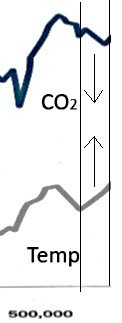
An Inconvenient Truth’s 600,000 year graph compresses time into a very short line. This expanded part of the graph at 500,000 years ago is an example showing:
Carbon dioxide drops while temperature rises then fails to rise proportionally to temperature for about 35,000 years.
As shown by the arrows to the right, temperature rises while carbon dioxide falls for about 13,000 years.
These data inconsistencies say there must be more than one more major factor influencing climate change.
The graph below shows:
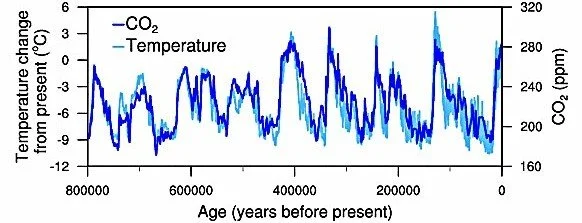
The carbon dioxide and temperature lines move together in this 800,000 year ice core graph as they would in a highly compressed time line where 1,000 years are a hair’s width.
The presentation of this graph makes it much easier to see the differences between CO2 and Temperature than in An Inconvenient Truth’s split level graph.
Carbon dioxide spiked above 280 ppm four time between 400,000 and 100,000 years age, each spike lasting thousands of years - without any human generated greenhouse gases.
Each spike, lasting thousands of years, was hotter than it is today.
Jouzel et al, 2007; Luthi et al, 2008 : NOAA National Centers For Environmental Information
WHAT ARE CLIMATE SCIENTISTS SAYING NOW?
Rather than carbon dioxide leading temperature, detailed analysis of the ice core data by climate scientists has found that it is temperature that leads carbon dioxide.
Dr. Florides summarized the work of his team saying:
“Temperature rises first, followed by an increase in atmospheric CO2.” Global Warming and Carbon Dioxide Through Sciences, Research Gate:
DOI: 10.1126/science.1078758
Dr. Caillon’s team found that temperature leads carbon dioxide saying: “CO2 increase lagged Antarctic deglacial warming (temperature) by 800 +/- 200 years”.
https://pubmed.ncbi.nlm.nih.gov/12637743/
Dr. James Lovelock, a highly respected scientist, early carbon dioxide advocate and author of The Revenge of Gaia (2006) did something in 2014 scientists rarely do. He reversed his carbon dioxide advocacy saying it was a mistake to say carbon dioxide controls temperature.
“We're no longer in a position to say that just because carbon dioxide rises … the temperature will rise likewise.”
How could Dr. Lovelock and so many climate scientists have gotten it wrong? He said:
“We were carried away by the (correlation of) the ice cores of Antarctica.” The quotes are from the Toronto Globe and Mail, Nelles interview, July 11, 2014.
IS THE CURRENT CLIMATE CHANGE CATASTROPHIC ?
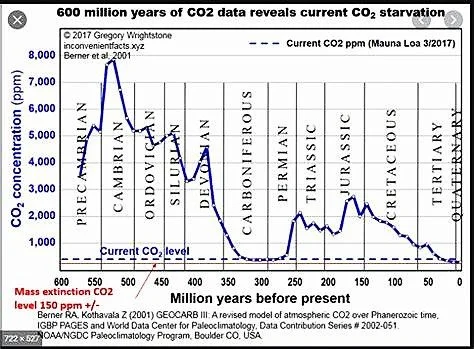
Dr. Wrightstone’s 600 Million Year Graph shows the Triassic and Jurassic Eras when giant reptiles dominated the earth. Carbon dioxide levels were four to six times higher than today. The fossil records show that dinosaurs thrived. Plants thrived. Coral, clams and shell fish thrived in higher ocean temperatures. The oceans did not become acidic because of the higher temperatures and the much higher levels of atmospheric carbon dioxide.
Note the “Current CO2 level” dotted line near the bottom of the graph and the thin black line just below it titled “Mass extinction level 150 ppm” (parts per million) of air for plants.
PLANTS Carbon dioxide is for plants what oxygen is for us. When carbon dioxide levels plunged during the ice ages to 180 ppm (parts per million) it was starvation level for plants. Plants thrive in higher levels of carbon dioxide. Their ideal level is four times higher than today’s so-called catastrophic level of 420 ppm. Many greenhouses operate at levels carbon dioxide two to three times higher than 420 ppm. Workers do not require special breathing apparatus in those enriched carbon dioxide environments. OSHA’s Permissible Exposure Limit (PEL) is 5,000 ppm of CO2 over an 8-hour work day.
Dr. Patrick Moore (a Greenpeace Co-founder) Should We Celebrate Carbon Dioxide
The Global Warming Policy Foundation https//www.thegwpf.org
Anran Wang, et al., Zhejiang University, Hangzhou, China
CO2 enrichment in greenhouse production: Towards a sustainable approach.
Rising levels of carbon dioxide make plants more productive which is helping feed our ever increasing global population. We also benefit by more productive plants consuming more carbon dioxide per plant and producing more oxygen. “From a quarter to half of Earth’s vegetated lands have shown significant greening over the last 35 years largely due to rising levels of atmospheric carbon dioxide ...”
https://www.nasa.gov/technology/carbon-dioxide-fertilization-greening-earth-study-finds/
THE OCEAN Is runaway, catastrophic global heating really in our future?
Graphs by climate scientists at Berkeley Earth show that atmospheric temperatures have risen 2 C (3.6 F) since 1830 CE. Incidentally, that was also the end of The Little Ice Age. Happily, the temperature when up instead of further down.
The upper ocean (200 m, 600 ft.) temperature has only risen 1 C (1.8 F).
Most of the vast, deeper ocean (3,650 m, 12,000 ft.) has remained at 4 C (39 F).
NASA scientists says the ocean capture 93% of the atmosphere’s excess heat. The United Nations (un.org) concurs: “The ocean … captures 90 percent of the excess heat generated by (greenhouse gas) emissions.”
Dr. Lovelock said: “The ocean’s heat capacity is about 1,000 times greater than that of the land and atmosphere”. (Nelles interview as cited above.)
CLIMATE MODELLING
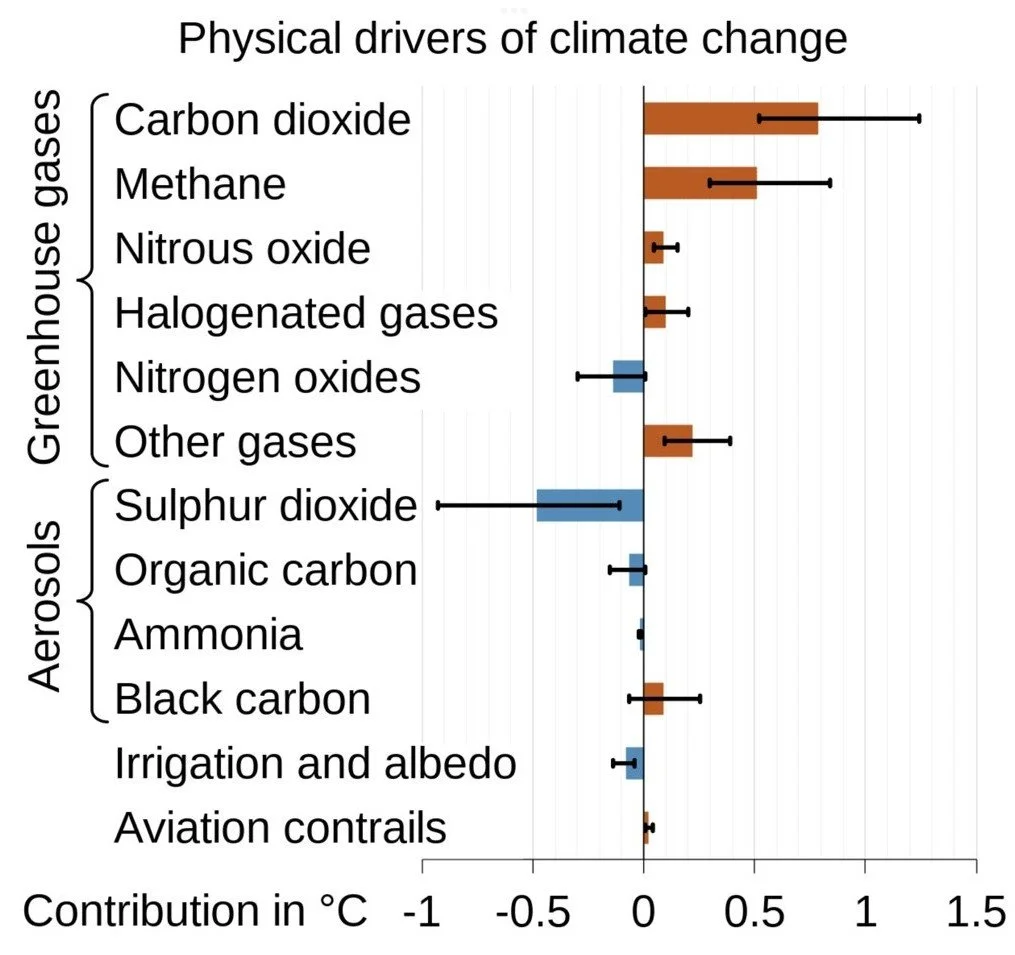
This is the land of modelling uncertainty. In its AR6, Leadership Summary, WG1, the Intergovernmental Panel on Climate Change (IPCC) shows this greenhouse gases chart. The color bars show the IPCC’s atmospheric Global Warming estimate for each gas. The black bars show the large range of uncertainty they assign for each element which is typically more than 50%. Uncertainty ranges of that size have a major impact on climate modelling.
Carbon dioxide is the radiative forcing standard that all other GHGs are rated with.
GASES: 5 heat (orange)
1 cools (blue)
AEROSOLS: 3 cool
1 heats
The cooling aerosols and gases (blue) cancel all of the smaller heating gases (orange) leaving only carbon dioxide’s 420 ppm and methane’s 2 ppm.
When we talk about greenhouses, we’re really talking about carbon dioxide and methane.
CLIMATE MODELLING PROBLEMS
Dr. Patrick Moore said, “The only trends the computer models seem able to predict accurately are ones that have already occurred.” Should We Celebrate Carbon Dioxide
The output is only as reliable as accuracy and completeness of the modeller’s input. All models are built on assumptions, and even the most detailed ones can’t capture how the world actually works. (Steven Poloz, Governor, Bank of Canada, 2013 - 2020)
An IPCC statement about modelling: “In climate research and modelling, we should recognize that we are dealing with a coupled non-linear chaotic system, and therefore that the long-term prediction of future climate states is not possible.”
Many climate scientists are questioning the U.N.’s IPCC climate prediction models. Click scholar.google.com and paste “criticism of IPCC modelling” in the search window, not the URL line.
CARBON DIOXIDE
Global Carbon Dioxide Emissions in gigatons (Gt) in 2022.
Total 889
All Natural sources 848
Human Sources 41 Gt. Includes CO2 released making cement, fossil fuels
Fossil Fuels 37.8 Gt.
Fossil Fuel Emissions were only 4.3% of the total global carbon dioxide emissions total.
Springer, 2022 Data; IEA, Global Energy Review 2025, p.31; CoPilot
METHANE
“The CCMI models estimate the tropospheric methane lifetime at about 8 years (average over years 2000–2009), with a range of 7.2 to 10.1 years.” There are more studies listed in Section 3.3.5 confirming the Morganstein study. The IPCC that says a methane molecule has a 100 year life span which is the basis for the orange color bar being far wider that 2 ppm.
CCMI, Section 3.3.5 “Approximately 40% of methane is emitted into the atmosphere by natural sources and about 60% comes from anthropogenic sources.” Of humanity’s 60% “the largest emissions (are) from rice cultivation in Asia, accounting for 30 % to 50 %.” (Fig. 3) Humanity’s contribution from rice farming needs to be adjusted because rice is often grown on converted wetlands, a natural source of methane. Attributing 1/3rd of rice cultivation’s methane to wetlands changes the balance to approximately 50% - 50% between human and natural sources. With the world’s ever increasing population and rice being a staple of the countries with the higher population growth rates, it appears highly likely that global methane levels will exceed the 2024 level of 1,921 parts per trillion (NOAA) which rounds to 2 parts per million in the atmosphere.
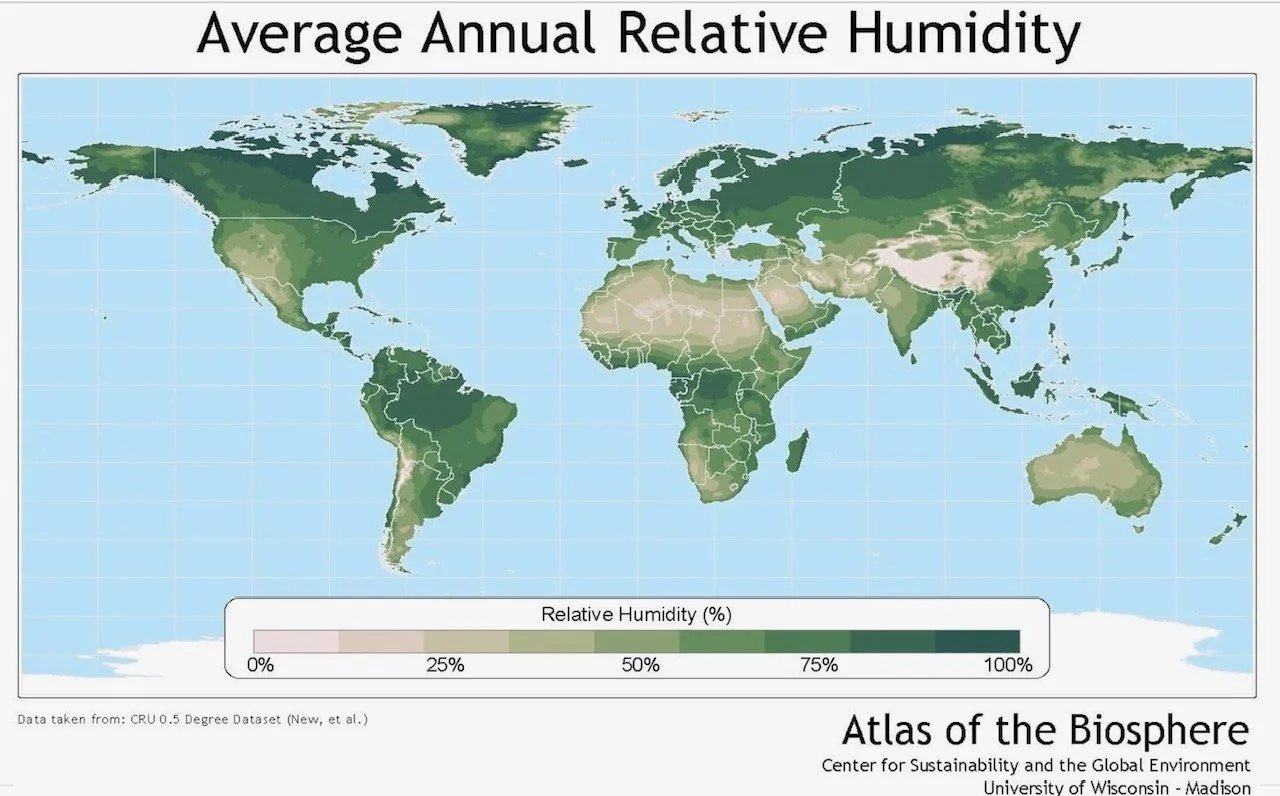
Why isn’t humidity part of the greenhouse conversation? The MIT Climate Portal says it’s because a water vapor molecule’s time in the atmosphere is only days or weeks. But it’s the constant total daily volume that matters, not how long an individual molecule lasts. Another answer is that it is nature and can’t be regulated so why talk about it? A third response is that humidity’s dominance diminishes the importance of the carbon dioxide - methane narrative
HUMIDITY
The Troposphere is the lowest level of the atmosphere towering 10,000 m (33,000 ft) high within 30 degrees of the sun’s zenith. The soaring tropical troposphere bulge diminishes to 3,000 m (10,000 ft) in the polar regions. Above the troposphere water vapor is almost non-existent at 2-5 ppm in the ultra dry and intensely cold stratosphere.
Atmospheric Water Vapor Often called humidity, it’s unique among the greenhouse gases because it only exists in quantity in the troposphere. The troposphere contains 38,000 ppm of water vapor at 30 C (86 F) and 90% relative humidity, typical in the tropics and summer conditions in the world’s humid mid latitude regions. Higher temperatures can raise water vapor to 70,000 ppm.
WHY ISN’T HUMIDITY Included In The Greenhouse Gases Conversation
The MIT Climate Portal says it’s because a water vapor molecule’s time in the atmosphere is only days or weeks. With 60% of earth’s surface always within the sun’s zenith and 70% covered by ocean, high amounts of humidity are a constant. True, there is a vast difference between the humidity levels in the Congo and the Sahara and other jungle-desert regions but that is easily averaged. The constant total daily volume is what matters, not how long an individual molecule lasts.
It is also true is that humidity only exists in the troposphere. Air thins as altitude increases decreasing carbon dioxide and methane per unit volume of air. 425 ppm at sea level decreases to 100 ppm about 5 mi (8 km) high which is the global average height of the troposphere. (Duck.ai sourcing Anthropic and others.)
The IPCC acknowledges humidity as an important GHG but focuses on carbon dioxide and methane because “humidity levels are more variable and influenced by natural processes”. In other words, it’s nature and can’t be regulated so why talk about it?
A cynical variance of that is humidity’s dominance diminishes the importance of the carbon dioxide - methane narrative.
THE GREENHOUSE GASES ARE WHAT GETS HEATED
continued …
RADIATIVE FORCING IS HOW THEY GET HEATED
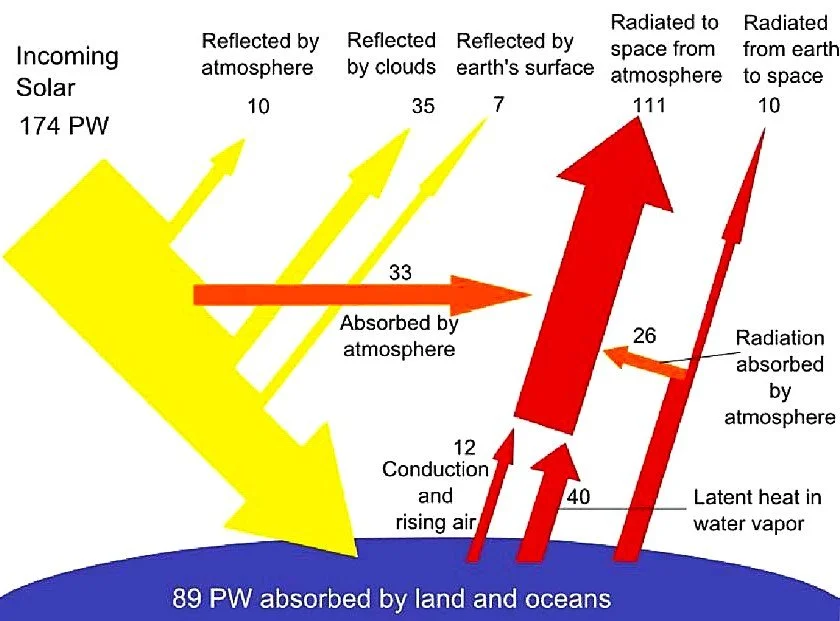
Graph by Frank van Mierlo : PW is a petawatt, one billion million watts of energy.
Radiative Forcing has a vast number of interactive components, most with a wide range of variability. And there are likely to be even more as yet unknown components, all of which render precise quantitative measurements impossible.
Ever so briefly, the sun’s short wave energy heats the land and sea. 75% of that solar energy hits earth within the sun’s zenith, 30 degrees of latitude. 90% hits within 40 degrees of latitude. That energy envelope shifts northward and southward following earth’s annual tilt on its axis. See Milankovitch Cycles below.
On land everything heated by shortwave energy gives off heat now as long wave energy that heats greenhouse gases. The gases, dominated by humidity, are a secondary planet warmer. Some of their energy is absorbed by plants while earth’s energy balance shifts the rest of it towards the polar regions. During that process atmospheric heat energy works its way up and out of the atmosphere. Radiative Forcing and Earth’s Energy Balance are explained in a NASA Tutorial from 2009. (Some of the information may be dated.)
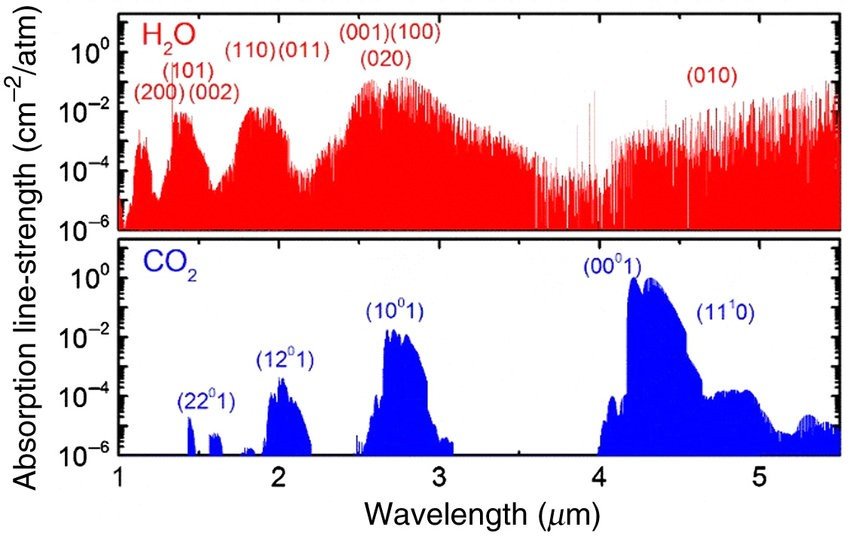
How dominant is humidity compared to carbon dioxide and methane? Water vapor’s (red) broad spectrum absorption ability of short wave and long wave radiation is compared to carbon dioxide’s (blue) limited absorption bands as shown in this 2021 graph. Short wave to long wave radiation is shown from left to right.
Dr. G. Yu DOI: 10.1117/1.OE.60.10.104103
The IPCC says “Water vapour is the most abundant radiatively active gas, accounting for about 75% of the terrestrial greenhouse effect ...” The Physical Science Basis 2021, Section 1.3.3, Page 179. Water vapor’s radiative forcing value is rated at half of carbon dioxide. At 38,000 ppm within the sun’s zenith, humidity’s radiative forcing value is 19,000.
Methane’s atmospheric 2 ppm has a long accepted ratio of being 20 times more potent than carbon dioxide making methane equivalent to 40 ppm carbon dioxide. Together their radiative forcing value of 460, making water vapor (19,000/ 460) a 41 times greater heater than all of the other gases and aerosols combined. Some sources claim methane’s radiative forcing value is 40 times greater than carbon dioxide. If correct, water vapor is 38 times greater. All of those values are based on long term atmospheric modelling values rather than what is physically present in the air .
EARTH’S ENERGY BALANCE
Our planet’s atmospheric circulation follows the Second Law of Thermodynamics, moving heat energy from the tropics toward the polar regions. Heat energy escapes the planet through two primary mechanisms.
EVAPORATION – CONDENSATION Short wave solar radiation heats the upper layer of the oceans (200 m, 660 ft). When water temperature exceeds air temperature, water evaporates, drawing energy from the water. Long wave radiative forcing energy that hits liquid water is completely absorbed within a hair’s width of the surface causing evaporation. Counter intuitively, warm moist air is less dense and rises. It releases that heat energy high in the sky as it cools forming water droplets and ultimately clouds. The atmosphere is 3 to 5 times less dense at cloud level causing an equivalent reduction the density of greenhouse gases making making it increasingly easy for heat energy to escape from earth.
DRY AIR COLUMNS Short wave solar radiation is the main driver in arid regions because long wave radiative forcing energy (your kitchen microwave) has little effect in the absence of liquid water and humidity. Vast heated air columns rise (like hot air balloons) high in the atmosphere releasing heat energy until it reaches equilibrium with the colder, thinner surrounding air - again facilitating escape from planet.
Humanity’s additional greenhouse gases are said to be overloading that balance causing global warming. But is it?
That theory does not fit with the world being hotter than today from 6,000 to 10,000 years ago when carbon dioxide was just over half of today’s level.
And it does not fit with the global carbon dioxide and temperature ranges shown in The 500 Million Year graph.
Protein, a key element of life, starts to break down when the body temperature reaches 41 C (106 F). Dinosaurs could not have survived when earth’s average temperature 86 F (30 C) degrees with summer temperatures must have soared into the 50s C (140 F).
Something must have limited earth’s maximum temperatures.
RADIATIVE COOLING
The answer lies in the physics of the Stefan – Boltzmann Law and the Planck Response.
Stefan-Boltzmann Law - hotter objects emit more radiation.
Planck Response - infrared radiation increases as surface temperature rises.
As earth warms, exponentially more energy is radiated into space counteracting the warming.
“Temperature doesn’t infinitely rise, however, because atoms and molecules on Earth are not just absorbing sunlight, they are also radiating thermal infrared energy (heat). The amount of heat a surface radiates is proportional to the fourth power of its temperature. If temperature doubles, radiated energy increases by a factor of 16 (2 to the 4th power). If the temperature of the Earth rises, the planet rapidly emits an increasing amount of heat to space”. NASA
[ If an object’s temperature rises from 10 to 20 C, it releases 16 times as much energy.]
The Forcing – Cooling relationship is somewhat like a car’s cruise control but with a more gradual, analogue type response. It’s a Ying cooling response to climate warming’s Yang. Our planet has the ability to handle increasing greenhouse gases without going into extreme heat overdrive.
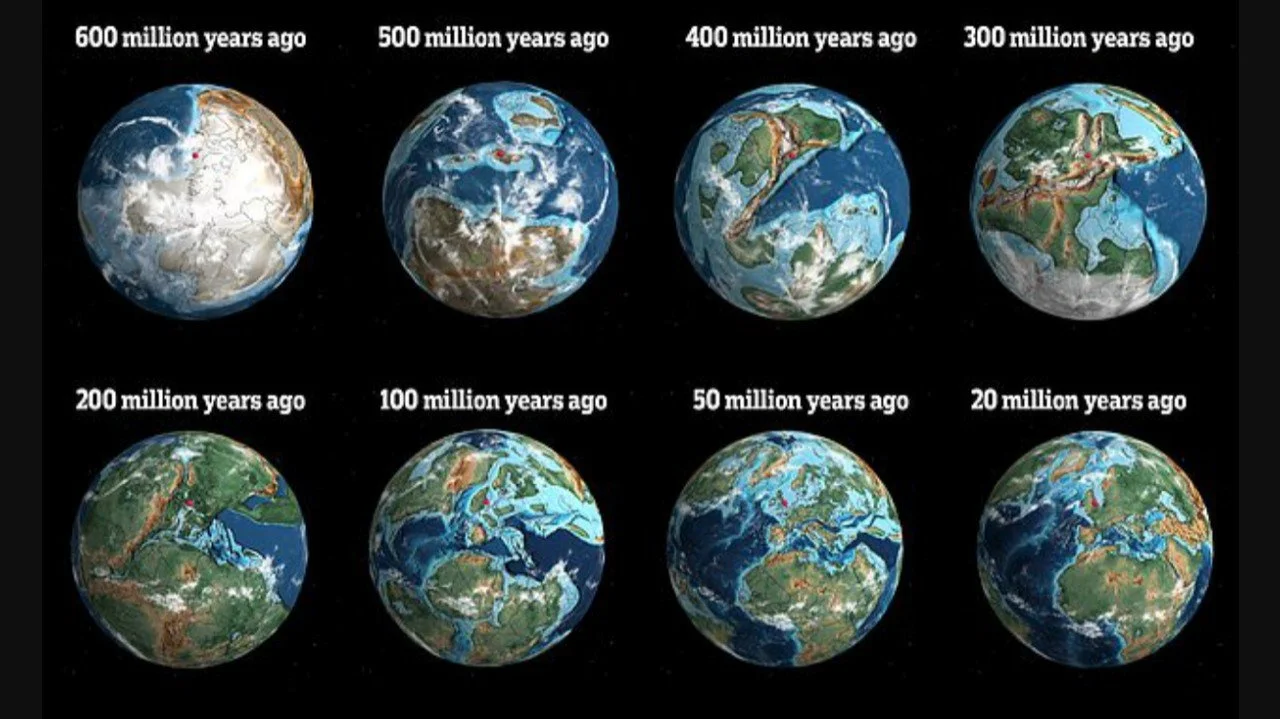
During the higher average planet temperatures millions years ago, continents were closer to the equator giving ocean currents more access to the polar regions, enhancing the global energy balance. This image was created by Ian Webster from the work of Dr. C. R. Scotese.
NATURE’S FORCES AFFECTING CLIMATE CHANGE
Nature has been changing the climate since the world began without any help from mankind’s greenhouse gases. One of the many ways is a theory developed a century ago by ground breaking structural engineer turned astrophysicist Dr. Milutin Milankovitch.
Dr. Milankovitch formulated three theories:
• Orbital Eccentricity: Earth’s orbit around the sun changes from round (warmer) to oval (cooler) in 100,000 year cycles.
• Axial Obliquity: How far the earth’s hemispheres tilt toward and away from the sun between summer and winter varies in 41,000 year cycles.
• Axial Precession: The earth also leans like a wobbling top swinging the polar regions toward and away from the sun in a 26,000 year circle. It’s currently warming the southern hemisphere more in its summer than the northern hemisphere in its summer. It’s about to reverse but will take thousands of years to give more summer warmth to the northern hemisphere. Images courtesy of NASA.
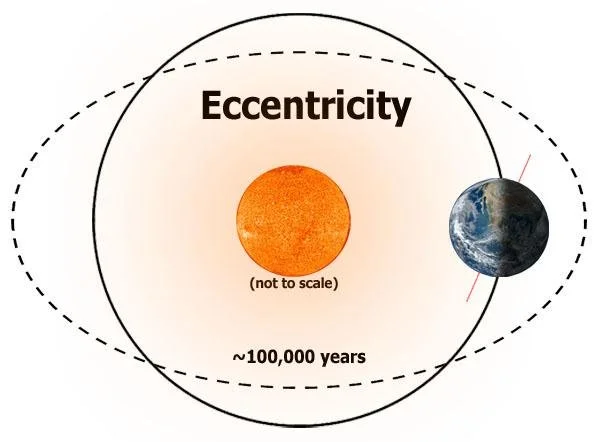
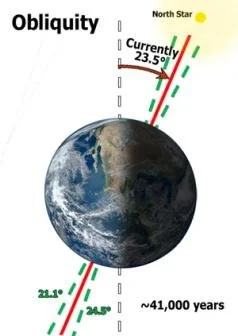

Highly accurate technology and computing power have confirmed Dr. Milankovic’s theories. Climate scientists have noticed a loose correlation between cooling alignments and the ice ages of the last two and a half million years. Research is investigating how much these three factors can heat and cool earth’s climate. Yet the Milankovic Cycles have been in motion for hundreds of millions, if not billions, of years. Why has earth’s climate been so much cooler for the last two and a half million years?
CASSIOPEDIA - HD 7977
Recent astrophysics research found that a star of the Cassiopeia Constellation passed close enough to our solar system 2.8 million years ago to disturb the orbits of our giant outer planets. Their orbital wobbles in turn disturbed earth’s orbit. This occurred shortly before the start of the current progression of ice ages and interglacial warm periods (including the one we live in). Did earth’s orbit return to its pre-Cassiopea fly-pass pattern or has its orbit been permanently affected? The discovery of the Cassiopeia star’s fly-by has changed a long held belief by astrophysicists that our solar system was not influenced by other stars. More climate related astronomical discoveries are likely. Astrophysical Journal Letters, Kaib, et al.
Digressing for a moment - Mars is smaller than earth and closer to Saturn, Jupiter and Uranus. It’s solar orbit would have been even more affected than earth’s solar orbit. What effect did that have on Mars. Has Mar’s solar orbit recovered?
POLAR MOVEMENT
Another interesting relationship is the correlation between climate change and the movement of earth’s magnetic north pole. In 200 AD (red dot upper left) earth’s magnetic north pole was located on the coast of Siberia. The middle east was referred to as The Fertile Crescent, then a green and temperate region. By 750 AD the magnetic north pole had moved to the northern tip of Canada’s Baffin Island. The middle east had become hotter and dryer. In 1,000 AD the magnetic north pole was at the geographic north pole. Europe and some other parts of the world were experiencing the Medieval Warm. By 1,500 the magnetic north pole was in the Arctic Ocean slowly migrating to Canada’s northern coast. The Little Ice Age had begun. The magnetic north pole stayed near Canada’s north shore until fifty years ago when it began to move rapidly north and west toward Siberia. Now it’s closer to Siberia than Canada again and the world is warming. Fertile Crescent Reference: https://doi.org/10.1126/science.abg4044
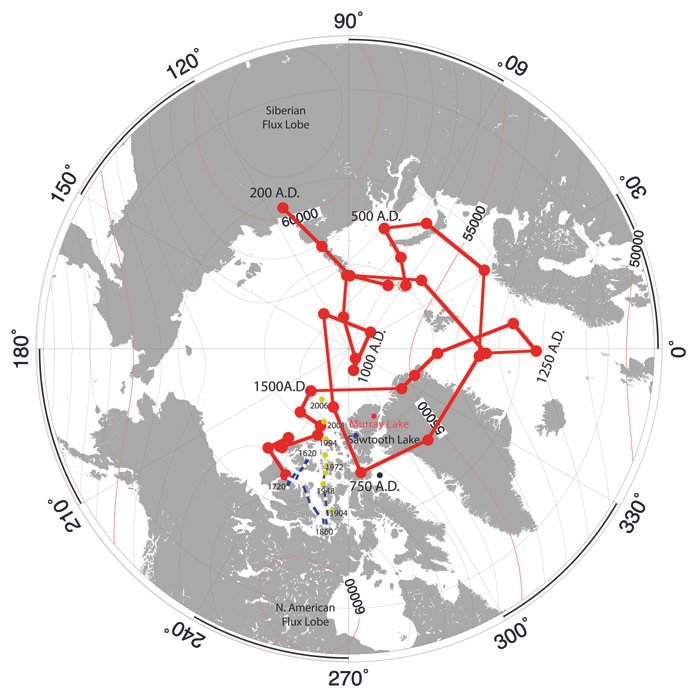
Researchgate.net Each dot represents a 50 yr. progression.
Is this correlation between climate change and pole movement just a coincidence or is it suggesting a real possibility ? “Analysis of the movement of the Earth's magnetic poles over the last 105 years demonstrates strong correlations between the position of the north magnetic, and geomagnetic poles, and both northern hemisphere and global temperatures. Although these correlations are surprising, a statistical analysis shows there is a less than one percent chance they are random …”
A.K. Kerton, 2009 : Climate Change and the Earth’s Magnetic Poles, A Possible Connection
While it is highly likely that the movement of earth’s magnetic poles are contributing to climate change, how is that possible since air is not attracted to magnetism? Recent research found that the movement of earth’s magnetic poles causes gravity waves which affect earth’s very high altitude magnetic radiation shield. That affects air currents in the earth’s upper atmosphere. Image: Solar radiation hitting earth’s magnetic radiation shield (not to scale).

Jing Liu, et al. Solar flare effects in the Earth's magnetosphere, Nature Physics (2021)
Could the movement of earth’s magnetic poles be affecting air and ocean currents another way? Curiously, while water is attracted to static electricity, water is diamagnetic - repelled by magnetism. Could the higher density of water in atmospheric rivers and hurricanes be enough for them to be affected by the movement of earth’s magnetic poles? Could the differences in density due to temperature layers and salinity concentrations be enough to affect ocean currents? And if so, to what extent?
THE SUN
Yet if everything currently known about climate change conspired to reach its maximum cold phase at the same time, it still wouldn’t be cold enough to explain the abrupt 1,200 year long plunge to the near ice age temperatures of the Younger Dryas (12,700 to 11,500 years ago). What caused that abrupt plunge and equally fast recovery? Could it happen again? The simplest explanation is the sun. We’ve always been told the sun’s strength doesn’t change. It might be time to rethink that. [The Lake Agassiz out pouring theory is uncertain.]
“The sun is the ultimate factor in causing change of the terrestrial climate. At a small but measurable level, the sun varies, just like most of the stars do.”
Dr. W. W. Soon, Astrophysics (Harvard), Climate Change : The Facts, chapter 4, page 57.
It’s been known for centuries that the sun’s north and south poles reverse like clockwork every eleven years. When they reverse there is a sharp rise in sun spot (solar storm) activity as shown in the even march of the blue spikes. The black line shows the moving average number of sun spots. During the Maunder Minimum it flat-lined which coincided with the coldest part of the Little Ice Age. The Dalton Minimum also had significantly fewer sun spots and was the last cold phase of the Little Ice Age. Is the drop in temperature and sun spots a coincidence?
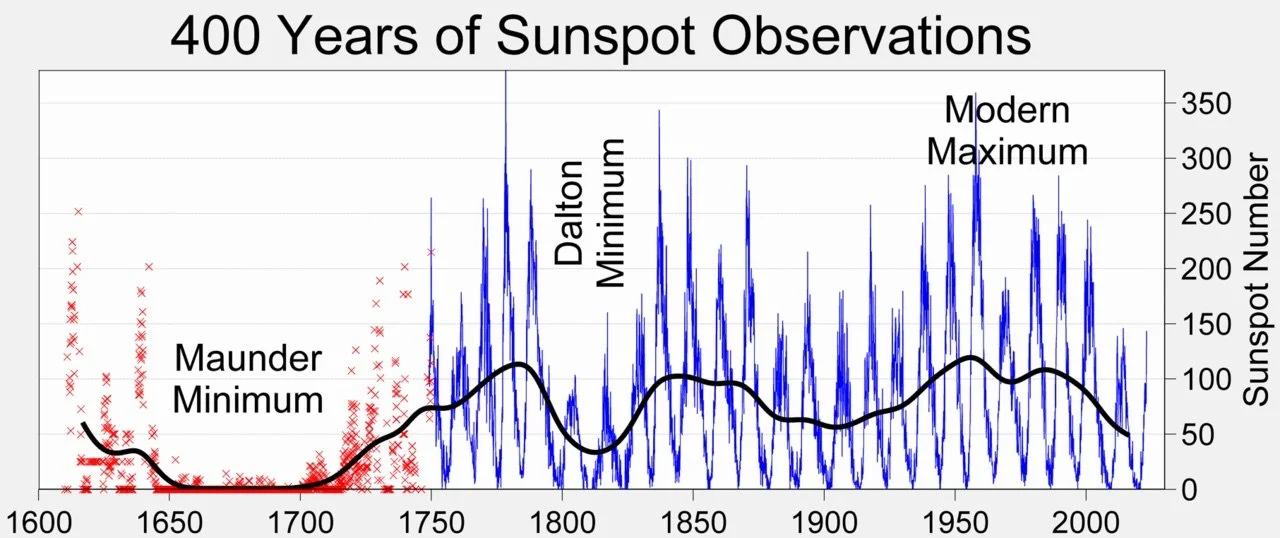
Maunder Minimum : Author Unknown
Paraphrasing a research paper by Dr. Schmutz: The correlation between the sun’s strength and temperature for 660 years indicates a 98% probability that the Little Ice Age was caused by variations in the sun’s strength. If the period is limited to 1650 to 1890, the probability increases to 99.99%. Schmutz WK, https://doi.org/10.1051/swsc/2021016
POPULATION
Missing in action from the climate change debate is the increase in global population. A search of the internet including two AI sites for a “graph showing population and global temperature since 1800” didn’t find any. This graph was created by Gemini for this website.
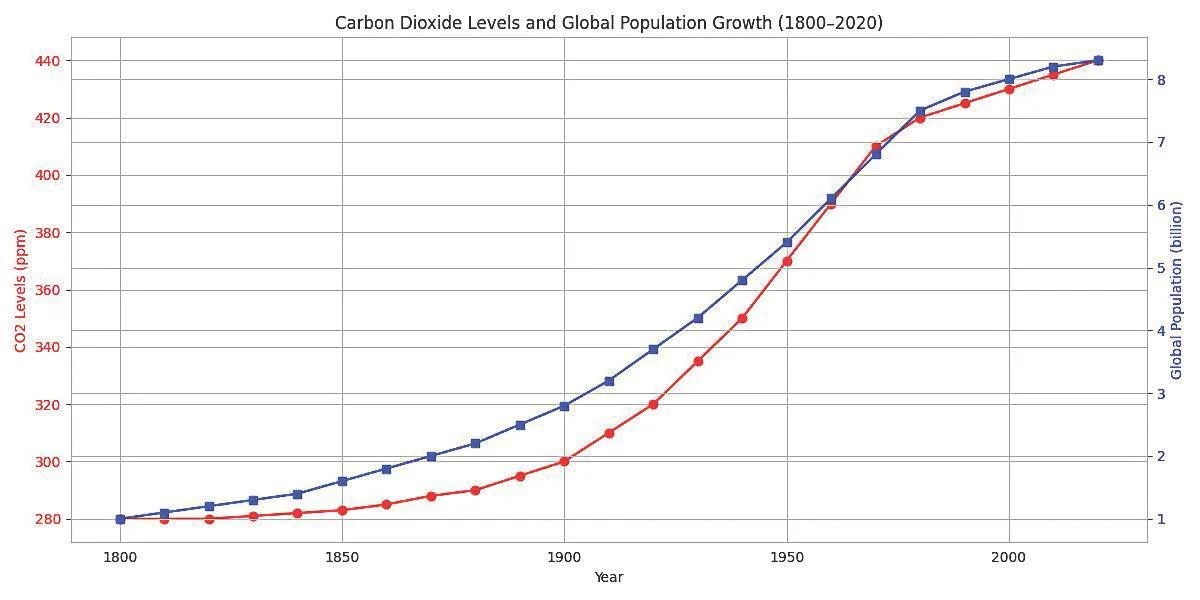
This shows a strong similarity between the carbon dioxide and population curves. Logic requires that those who believe the temperature-carbon dioxide graph is proof carbon dioxide causing climate change must also believe this temperature-population graph proves population growth is equally responsible for causing climate change. Happily, we now know that:
The ice cores show that carbon dioxide follows temperature by 800 years.
Humidity is a far larger factor in radiative forcing than carbon dioxide.
A global temperature increase would be moderated by radiative cooling.
But as always, graphs show a correlation, a suggestion and never proof of anything.
The global population is expected to grow from 8 to 10 billion by 2050, a 25% increase. The probability and its implications deserve serious consideration.
THE FUTURE
We have had 450 years of very slow climate change causing generation after generation to believe the climate doesn’t change. Now we see it changing. Research since 2003 has caused many climate scientists to believe that greenhouse gases (excluding water vapor) are neither the sole cause of climate change and nor even a dominant factor. Some question whether greenhouse gases are even involved at all.
The forces of nature are now in a warming phase and they are calling the shots as they always have. The climate history of the last 10,000 years suggests the global average annual temperature will rise 1 C (1.8 F) to its long term average. The physics of Radiative Cooling will moderate planetary temperature increases. Climate history also says that abrupt, extreme climate change is highly unlikely.
Email : climate.science.123@gmail.com